

Genius and Caprice: Wunderkammer, Surrealism and the Contemporary Collector
19 June 2026
Share
By Victoria Comstock-Kershaw - an arts writer, journalist, and critic.
"The most ordinary things, the most common and familiar," wrote Montaigne, "if we could see them in their true light, would turn out to be the grandest miracles of nature." He was writing in the 1580s, before the Wunderkammer had a theory of itself, but he could have been writing its manifesto. The collecting impulse that swept through the courts and merchant houses of Renaissance Europe ran on a conviction that the Surrealists would pick up on and return to: that the right object, placed in the right proximity to the wrong other object, could make the familiar - as Surrealist André Betron would put it centuries later – “convulsively strange.”
The earliest version of this juxtapositional style of collecting was the studiolo, a private room in a Renaissance palace where a collector arranged objects as a material self-portrait. Francesco I de' Medici filled his in Florence with instruments, minerals, and automata. This positioned him as sovereign of the world in miniature, both a representation of the collector's own wealth and intellect and a macrocosmic reflection of their society and universe. By the sixteenth century this had metastasised into the Wunderkammer (literally, room of wonders), which organised its holdings into two governing categories: naturalia, things produced by nature, and artificialia, things wrought by human hand. Ferrante Imperato, cataloguing his Neapolitan collection in 1599, described his objects as created by "the genius of man or the caprice of nature."
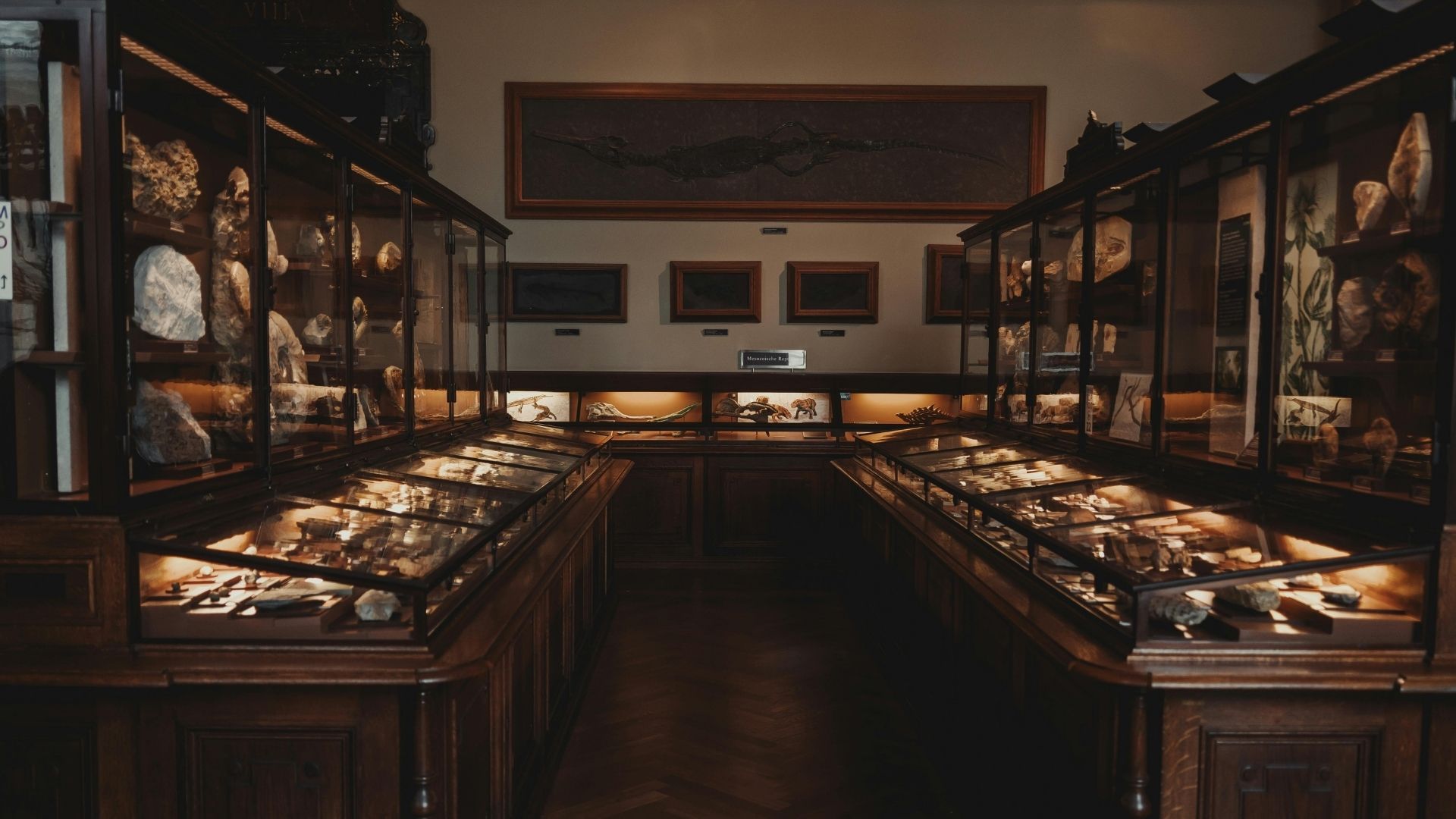 A contemporary Wunderkammer — echoing the tradition of cabinets of curiosity, where the boundaries between science, art and collecting dissolve.
The tension between those two forces was where the Wunderkammer lived. The most coveted objects were always those that sat uncomfortably in both categories at once, mirabilia, marvels that occupied the boundary between categories. The object that was simultaneously a natural specimen and a working artifact generated a specific kind of attention, one that later theorists of the Surrealist object would recognise immediately.
Francis Bacon, writing in 1605, dismissed the Wunderkammer as "frivolous impostures for pleasure and strangeness,” intending it as a condemnation. The Enlightenment duly obliged: by the eighteenth century the cabinet had been essentially rationalised out of existence, dispersing its contents throughout the disciplinary order of the modern museum and Linnean taxonomy. Naturalia went to natural history and artificialia went to decorative arts (the Enlightenment gallery at the British Museum can act as an illustration of this division); the productive confusion between them was resolved. The mirabilia had nowhere to go.
André Breton, luckily, knew where to find them. Working in the early twentieth century, he re-animated European pre-Englightment instincts with his flea market wanderings. This led to his conceptualisation of the objet trouvé, as well as an insistence that beauty should be “convulsive” (arresting, disruptive of rational order) or not at all. The Surrealists were drawn to the Wunderkammer model precisely because it predated the disciplinary order of Locke, Linnaeus and Darwin: it offered a historical precedent for organising objects through analogy and psychological association instead of the scientific taxonomy that had characterised the previous century. When the International Surrealist Exhibition opened in London in June 1936 to over 23,000 visitors in three weeks, it staged itself according to the logic of the mirabilia by using categorical instability as the governing principle. That exhibition’s catalogue (designed by Max Ernst, priced at sixpence) is now being shown by Pater Harrington at this year's fair: the document of that moment, now itself a collectible object, has migrated over ninety years from printed matter into artifact. The categories, as ever, have shifted.
The overlap between Surrealism and the Wunderkammer tradition is epistemological as much as aesthetic. Both refuse the museum's promise that objects can be fully explained by their categories (period, medium, provenance, function), and both locate meaning in the relational charge between things rather than in any single thing's intrinsic properties. For the contemporary collector, this has a practical implication: the most interesting acquisitions are often the ones that recontextualise everything around them and introduce a productive, convulsive friction into an established order. Treasure House Fair has, perhaps unsurprisingly, a few objects this June that make the case concretely.
Niyoko Ikuta's Ku-187 (Free Essence-187), shown by A Lighthouse called Kanata, sits squarely in the nautilus tradition. The nautilus cup (a spiralling shell, sometimes carved with intricate scenes, usually mounted in silver or gold) was among the most coveted objects in any serious Kunstkammer, praised for its representation of natural mathematics, complemented by human craft. Ikuta collapses that distance entirely, coiling cut and laminated sheet glass into an unmistakably biological form and presenting glass as an organism in categorical suspension, both formally and conceptually.

Ku-187 (Free Essence-187), Niyoko Ikuta, 2026. Cut, laminated sheet glass. Courtesy of A Lighthouse called Kanata.
The fair places this alongside Frank Partridge's pair of Louis XV lacquer commodes, made for Madame de Pompadour around 1745. Chinoiserie itself is a form of category confusion, translating Chinese naturalia into French decorative artificialia.
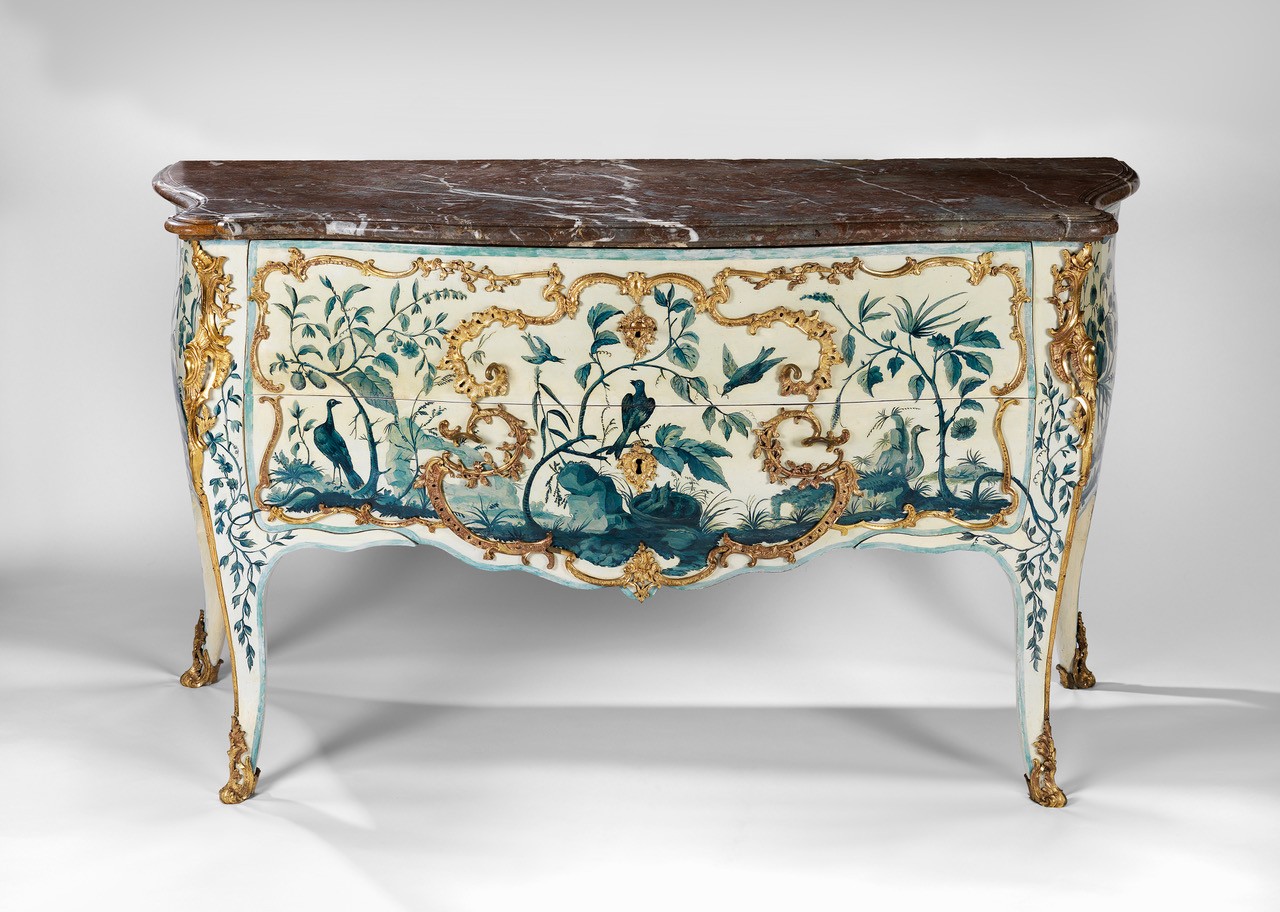
Pair of Louis XV lacquer commodes, circa 1745. Signed by Chevalier, owned by Madame de Pompadour and probably delivered to Versailles. Courtesy of Frank Partridge.
The Wunderkammer was always an argument made through adjacency, and Treasure House generates those arguments across five centuries of making and collecting: Florian Kolhammer's Secessionist armchairs, for example, designed by Olbrich and upholstered in Koloman Moser fabric, belong to a tradition that consciously dissolved the hierarchy between fine and decorative art. This is the same dissolution the Surrealists would later locate in the flea market object, the found thing elevated by attention into something charged with psychological meaning.
andFriedrichOttoSchmidt(execution_T639106509636_T639160756888724729.jpg)
Pair of secessionist armchairs by Joseph Maria Olbrich (design) and Friedrich Otto Schmidt (execution), late 19th century. Solid oak, brass, fabric. Courtesy of Florian Kolhammer.
The Surrealist tradition itself is also explicitly present at this year's fair, extending beyond the form of Peter Harrington’s first edition catalogue from the 1936 International Surrealist Exhibition. Rosior's diamond, sapphire, emerald and tsavorite garnet drop earrings in yellow gold enact the same categorical logic as the bezoar stone mounted in gold filigree that sat in every serious Kunstkammer: gemstones were among the most prized naturalia in the cabinet tradition, attributed with protective and sometimes magical properties. Their setting in precious metal, however, decisively placed them within the category of artificialia. The Surrealists understood this (as do contemporary jewelry designers, including Schiaparelli). Meret Oppenheim and Dalí made jewellery; Man Ray photographed it as erotic object; Calder hammered wire into ornaments he wore in his own pockets.
Diamond, sapphire, emerald and tsavorite garnet drop earrings, set in yellow gold. Courtesy of Rosior Jewels.
Rose Uniacke's pair of Cubosfera wall lights, designed by Alessandro Mendini for Fidenza Vetraria around 1968, arrive from a moment in Italian radical design explicitly engaged with Surrealist object theory. The displacement of function, the familiar made strange by formal decision, is materially present here. Glass, technically an amorphous solid suspended between liquid and mineral, has always been the Wunderkammer's most philosophically interesting material. The Cubosfera pieces make that instability decorative, which is itself a Surrealist move.
_T639168790945581087.jpg) Pair of Cubosfera Wall Lights, circa 1968. Brass and glass wall lights, with heavy brass wall fixing. Courtesy of Rose Uniacke.
Pair of Cubosfera Wall Lights, circa 1968. Brass and glass wall lights, with heavy brass wall fixing. Courtesy of Rose Uniacke.
Stone gallery's naturalia also harken to the Surrealist nature of the Wunderkammer tradition. A woolly rhinoceros foreleg, recovered from the North Sea and approximately forty thousand years old, is exactly the sort of large bone that Renaissance collections would attribute to giants, dragons - creatures outside of the taxonomic order that exceeded rational explanation. Alongside the rhinoceros leg, the gallery presents a fossil palm frond from Wyoming, fifty million years old and pressed into limestone as simultaneous geological specimen and image. In Dalí’s paintings in particular, bones recur as psychologically loaded objects, both as erotic symbols and momento mori, while the prehistoric geological formations of his native Cap de Creus appear as faces and half-formed creatures.
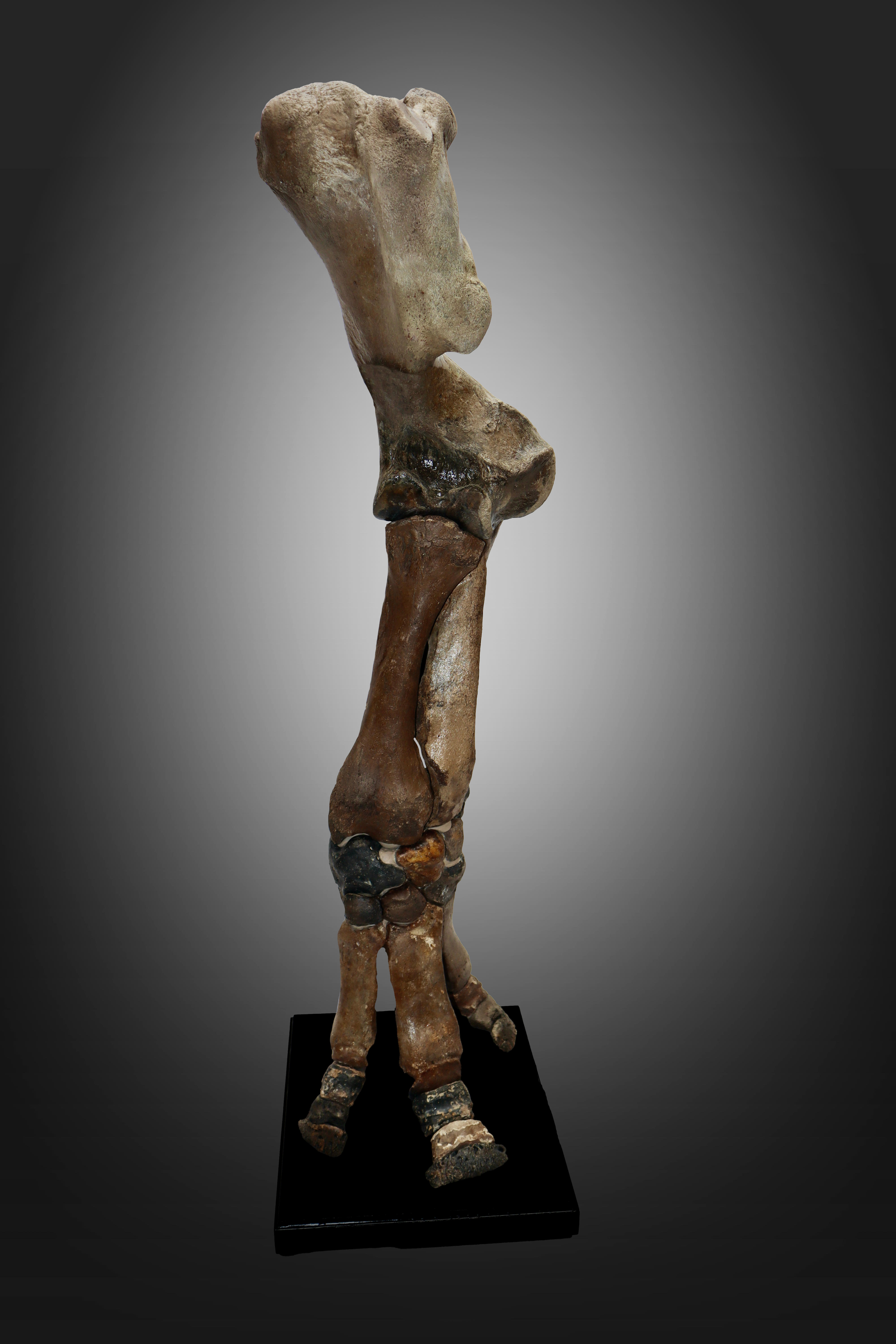 Front leg of a Woolly Rhinoceros, approx. 40 thousand years. Origin: North Sea, The Netherlands. Courtesy of Stone gallery.
Southampton City Art Gallery's Surrealist collection arrives at Treasure House Fair this June - Roland Penrose, Eileen Agar, Ithell Colquhoun and others, some of their works unseen publicly for years - ninety years on from the exhibition that first brought them to a British public. The mirabilia of one century have become the artificialia of the next, which is precisely what Malebranche observed of the Wunderkammer in the seventeenth century: that within it, "the price depends solely on imagination, on passion and on chance." Collecting was never a single-discipline proposition: its power has always derived precisely from the range of its holdings and the productive friction generated between them. This very dynamic is consciously perpetuated by Treasure House Fair.
"The most ordinary things, the most common and familiar," wrote Montaigne, "if we could see them in their true light, would turn out to be the grandest miracles of nature." He was writing in the 1580s, before the Wunderkammer had a theory of itself, but he could have been writing its manifesto. The collecting impulse that swept through the courts and merchant houses of Renaissance Europe ran on a conviction that the Surrealists would pick up on and return to: that the right object, placed in the right proximity to the wrong other object, could make the familiar - as Surrealist André Betron would put it centuries later – “convulsively strange.”
The earliest version of this juxtapositional style of collecting was the studiolo, a private room in a Renaissance palace where a collector arranged objects as a material self-portrait. Francesco I de' Medici filled his in Florence with instruments, minerals, and automata. This positioned him as sovereign of the world in miniature, both a representation of the collector's own wealth and intellect and a macrocosmic reflection of their society and universe. By the sixteenth century this had metastasised into the Wunderkammer (literally, room of wonders), which organised its holdings into two governing categories: naturalia, things produced by nature, and artificialia, things wrought by human hand. Ferrante Imperato, cataloguing his Neapolitan collection in 1599, described his objects as created by "the genius of man or the caprice of nature."
A contemporary Wunderkammer — echoing the tradition of cabinets of curiosity, where the boundaries between science, art and collecting dissolve.The tension between those two forces was where the Wunderkammer lived. The most coveted objects were always those that sat uncomfortably in both categories at once, mirabilia, marvels that occupied the boundary between categories. The object that was simultaneously a natural specimen and a working artifact generated a specific kind of attention, one that later theorists of the Surrealist object would recognise immediately.
Francis Bacon, writing in 1605, dismissed the Wunderkammer as "frivolous impostures for pleasure and strangeness,” intending it as a condemnation. The Enlightenment duly obliged: by the eighteenth century the cabinet had been essentially rationalised out of existence, dispersing its contents throughout the disciplinary order of the modern museum and Linnean taxonomy. Naturalia went to natural history and artificialia went to decorative arts (the Enlightenment gallery at the British Museum can act as an illustration of this division); the productive confusion between them was resolved. The mirabilia had nowhere to go.
André Breton, luckily, knew where to find them. Working in the early twentieth century, he re-animated European pre-Englightment instincts with his flea market wanderings. This led to his conceptualisation of the objet trouvé, as well as an insistence that beauty should be “convulsive” (arresting, disruptive of rational order) or not at all. The Surrealists were drawn to the Wunderkammer model precisely because it predated the disciplinary order of Locke, Linnaeus and Darwin: it offered a historical precedent for organising objects through analogy and psychological association instead of the scientific taxonomy that had characterised the previous century. When the International Surrealist Exhibition opened in London in June 1936 to over 23,000 visitors in three weeks, it staged itself according to the logic of the mirabilia by using categorical instability as the governing principle. That exhibition’s catalogue (designed by Max Ernst, priced at sixpence) is now being shown by Pater Harrington at this year's fair: the document of that moment, now itself a collectible object, has migrated over ninety years from printed matter into artifact. The categories, as ever, have shifted.
The overlap between Surrealism and the Wunderkammer tradition is epistemological as much as aesthetic. Both refuse the museum's promise that objects can be fully explained by their categories (period, medium, provenance, function), and both locate meaning in the relational charge between things rather than in any single thing's intrinsic properties. For the contemporary collector, this has a practical implication: the most interesting acquisitions are often the ones that recontextualise everything around them and introduce a productive, convulsive friction into an established order. Treasure House Fair has, perhaps unsurprisingly, a few objects this June that make the case concretely.
Niyoko Ikuta's Ku-187 (Free Essence-187), shown by A Lighthouse called Kanata, sits squarely in the nautilus tradition. The nautilus cup (a spiralling shell, sometimes carved with intricate scenes, usually mounted in silver or gold) was among the most coveted objects in any serious Kunstkammer, praised for its representation of natural mathematics, complemented by human craft. Ikuta collapses that distance entirely, coiling cut and laminated sheet glass into an unmistakably biological form and presenting glass as an organism in categorical suspension, both formally and conceptually.
Ku-187 (Free Essence-187), Niyoko Ikuta, 2026. Cut, laminated sheet glass. Courtesy of A Lighthouse called Kanata.
The fair places this alongside Frank Partridge's pair of Louis XV lacquer commodes, made for Madame de Pompadour around 1745. Chinoiserie itself is a form of category confusion, translating Chinese naturalia into French decorative artificialia.
Pair of Louis XV lacquer commodes, circa 1745. Signed by Chevalier, owned by Madame de Pompadour and probably delivered to Versailles. Courtesy of Frank Partridge.
The Wunderkammer was always an argument made through adjacency, and Treasure House generates those arguments across five centuries of making and collecting: Florian Kolhammer's Secessionist armchairs, for example, designed by Olbrich and upholstered in Koloman Moser fabric, belong to a tradition that consciously dissolved the hierarchy between fine and decorative art. This is the same dissolution the Surrealists would later locate in the flea market object, the found thing elevated by attention into something charged with psychological meaning.
Pair of secessionist armchairs by Joseph Maria Olbrich (design) and Friedrich Otto Schmidt (execution), late 19th century. Solid oak, brass, fabric. Courtesy of Florian Kolhammer.
The Surrealist tradition itself is also explicitly present at this year's fair, extending beyond the form of Peter Harrington’s first edition catalogue from the 1936 International Surrealist Exhibition. Rosior's diamond, sapphire, emerald and tsavorite garnet drop earrings in yellow gold enact the same categorical logic as the bezoar stone mounted in gold filigree that sat in every serious Kunstkammer: gemstones were among the most prized naturalia in the cabinet tradition, attributed with protective and sometimes magical properties. Their setting in precious metal, however, decisively placed them within the category of artificialia. The Surrealists understood this (as do contemporary jewelry designers, including Schiaparelli). Meret Oppenheim and Dalí made jewellery; Man Ray photographed it as erotic object; Calder hammered wire into ornaments he wore in his own pockets.
Diamond, sapphire, emerald and tsavorite garnet drop earrings, set in yellow gold. Courtesy of Rosior Jewels.
Rose Uniacke's pair of Cubosfera wall lights, designed by Alessandro Mendini for Fidenza Vetraria around 1968, arrive from a moment in Italian radical design explicitly engaged with Surrealist object theory. The displacement of function, the familiar made strange by formal decision, is materially present here. Glass, technically an amorphous solid suspended between liquid and mineral, has always been the Wunderkammer's most philosophically interesting material. The Cubosfera pieces make that instability decorative, which is itself a Surrealist move.
Pair of Cubosfera Wall Lights, circa 1968. Brass and glass wall lights, with heavy brass wall fixing. Courtesy of Rose Uniacke.Stone gallery's naturalia also harken to the Surrealist nature of the Wunderkammer tradition. A woolly rhinoceros foreleg, recovered from the North Sea and approximately forty thousand years old, is exactly the sort of large bone that Renaissance collections would attribute to giants, dragons - creatures outside of the taxonomic order that exceeded rational explanation. Alongside the rhinoceros leg, the gallery presents a fossil palm frond from Wyoming, fifty million years old and pressed into limestone as simultaneous geological specimen and image. In Dalí’s paintings in particular, bones recur as psychologically loaded objects, both as erotic symbols and momento mori, while the prehistoric geological formations of his native Cap de Creus appear as faces and half-formed creatures.
Front leg of a Woolly Rhinoceros, approx. 40 thousand years. Origin: North Sea, The Netherlands. Courtesy of Stone gallery.Southampton City Art Gallery's Surrealist collection arrives at Treasure House Fair this June - Roland Penrose, Eileen Agar, Ithell Colquhoun and others, some of their works unseen publicly for years - ninety years on from the exhibition that first brought them to a British public. The mirabilia of one century have become the artificialia of the next, which is precisely what Malebranche observed of the Wunderkammer in the seventeenth century: that within it, "the price depends solely on imagination, on passion and on chance." Collecting was never a single-discipline proposition: its power has always derived precisely from the range of its holdings and the productive friction generated between them. This very dynamic is consciously perpetuated by Treasure House Fair.